How Many Sets per Muscle per Week to Build Muscle
How many hard sets per muscle per week do you need to grow? A practical range, how to count sets, and how to adjust the volume to your recovery.
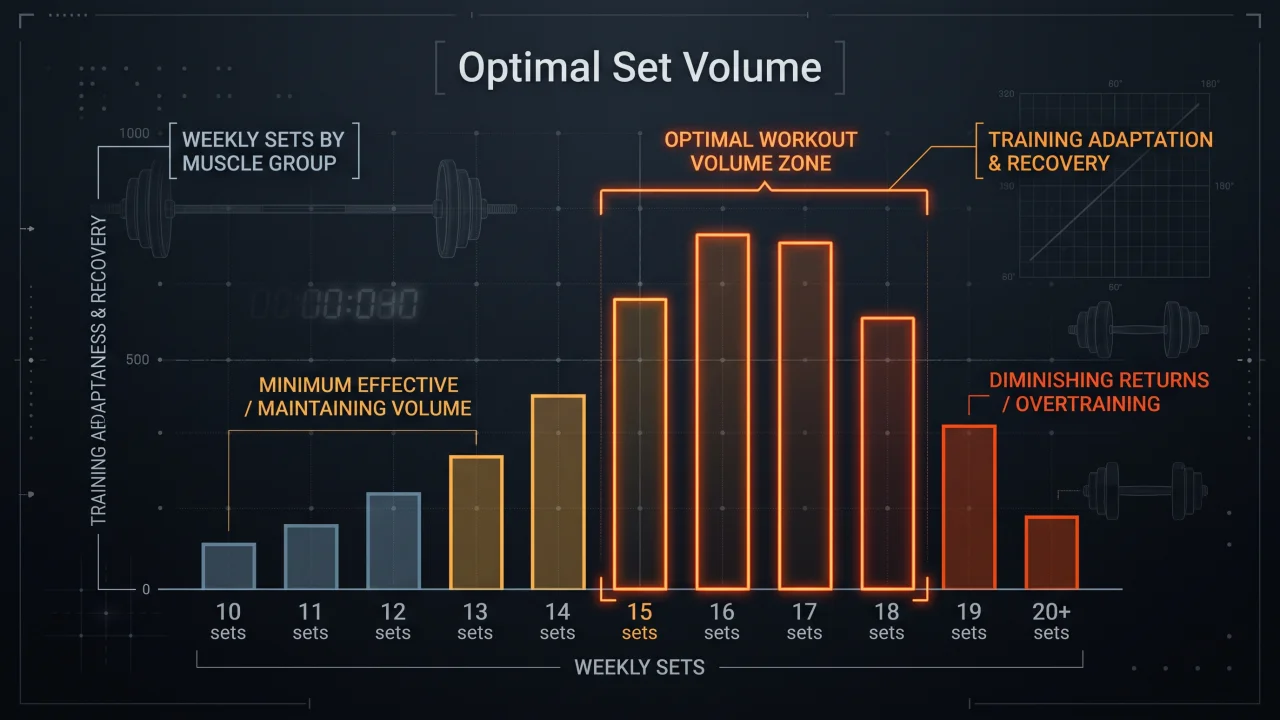
Weekly volume is one of the main levers of muscle growth, and also one of the easiest to get wrong. Too little and the muscle has no reason to grow. Too much and you pile up fatigue, skip workouts, and stop improving.
The most useful way to think about it is per muscle, per week. Instead of asking how many sets your workout has, ask how many hard sets each muscle received across all your sessions in seven days.
What counts as a set?
A set counts toward your weekly volume when it is a hard set: you worked close to failure, with a load that allowed roughly 5 to 30 reps, and with controlled technique. Warm-up sets, and sets stopped far from failure, are not part of the count.
This is why two people who both write down 15 sets can have very different volume. One of them may have done 15 sets with 3 or 4 reps still in reserve, and the other 15 sets taken near failure. The second person did more effective work.
- Count: working sets taken within about 0 to 3 reps of failure.
- Do not count: warm-ups, light technique sets, and sets stopped long before they got hard.
- Count partially: sets for a muscle that is only helping, like triceps in a bench press.
How many sets per muscle per week?
A practical range for most people is 10 to 20 hard sets per muscle per week. As a rule, very low volumes, below about 10 weekly sets, tend to produce slower gains, and the extra benefit shrinks as you go well beyond 20.
That is a guideline, not a law. Results vary from person to person, and nobody can promise that 14 sets will beat 12 for you. Treat the range as a place to start and let your own progress decide where you stay.
- Beginners: 6 to 10 hard sets per muscle per week is often enough, because almost any stimulus is new.
- Intermediate lifters: 10 to 16 hard sets per muscle per week.
- Advanced lifters or specialization phases: 14 to 20 hard sets for the muscle you want to bring up, while keeping the others near maintenance.
How do you count sets in practice?
Add up the hard sets for each muscle across the whole week, not per workout. Chest gets sets from bench press and from flies, and also a smaller share from shoulder presses. Back gets sets from rows and pulldowns, and biceps get a share from both.
A simple method is to count each direct exercise as one set for the target muscle and to count a half set for a muscle that works as a helper. If you do 3 sets of bench press, 3 sets of incline dumbbell press and 3 sets of flies, that is 9 direct sets for the chest, plus some work for the triceps and front delts.
You do not need to be exact. What matters is that the number is roughly right and that you track it the same way every week, so you can compare week to week.
How should you split the volume across the week?
Spreading the volume over two or more sessions per muscle is usually better than doing everything in one day. A set done on a fresh muscle is of better quality than the tenth set of the same session, when you are tired and reps are falling.
As a rule of thumb, try to keep each session for a given muscle at around 4 to 10 hard sets. If your plan puts 16 sets of chest into a single day, split them into two days of 8.
- 10 weekly sets: two sessions of 5, or three of 3 to 4.
- 16 weekly sets: two sessions of 8, or three of 5 to 6.
- Always leave at least a day of rest for the muscle between hard sessions when you can.
How do you know if the volume is right for you?
Use your own response as the judge. If your loads or reps go up over the weeks, if you recover before the next session, and if you still feel motivated to train, your volume is working.
If you are stuck for 3 or 4 weeks and you feel fresh, you may need more volume. If you are stuck and also tired, sore for days, and sleeping badly, you probably need less, not more.
Make one change at a time. A common way to progress is to add 1 or 2 sets per muscle per week, hold that for a few weeks, and only then raise it again. Every 6 to 8 weeks, a lighter week with about half of the sets lets fatigue dissipate.
Common mistakes with weekly volume
The first mistake is counting sets that were not hard. If you finish a set and could have done 10 more reps, it is practice, not volume.
The second is copying the volume of an advanced lifter. Someone who has trained for years recovers from, and needs, a different amount of work than someone in their first months.
The third is increasing volume when the real problem is something else. Poor sleep, low protein, and no load progression hold back growth, and more sets do not fix any of them.
Finally, remember that volume is only one piece. If the weights and reps never go up, adding sets just adds time in the gym. Progressive overload still comes first.
Track it with eBolts
Counting weekly sets by hand is tedious, and it is where most people give up. Log your workouts in eBolts and use your history to see how many hard sets each muscle received this week, then adjust the plan one small step at a time.
Frequently asked questions
How many sets per muscle per week are enough to grow?
For most people, 10 to 20 hard sets per muscle per week is a good range. Beginners often grow with 6 to 10 sets, while experienced lifters may need 12 to 20. Start at the low end of your range and add sets only when progress stalls and you are recovering well.
Do warm-up sets count toward weekly volume?
No. Warm-up sets are meant to prepare the muscle and the joints, and they are far from failure. Only working sets taken close to failure, with good technique, count toward the weekly number.
Is it better to do all the sets in one workout or spread them out?
Spreading them over two or more sessions per muscle is usually better. Sets done while fresh are higher quality than the last sets of a long session. A practical limit is about 4 to 10 hard sets for one muscle per workout.
How do I know if I am doing too many sets?
Signs include reps and loads falling for several weeks, soreness that lasts for days, poor sleep, and losing the desire to train. If that happens, cut the volume by about a third for a week or two and see whether your performance comes back.
Do I need more sets if I train with heavier loads?
Not necessarily. Heavy and light sets can both build muscle when they are hard enough. What matters is that the set is taken close to failure, so choose a load that lets you do roughly 5 to 30 reps with good technique.
Recommended gear
Affiliate links: we may earn a commission at no extra cost to you.
Put into practice: Routines & Guides
Follow workouts and detailed exercise biomechanics directly related to this article:
Track every set — free
Fractional loads, rest timer, history, last-time suggestions and progress charts. Works offline.
Create free account