Microloading: Why Small Weight Jumps Help You Progress
Why jumping 5 kg can stall your progress, how small plates and 1 kg steps keep you improving, and how to microload each exercise safely.
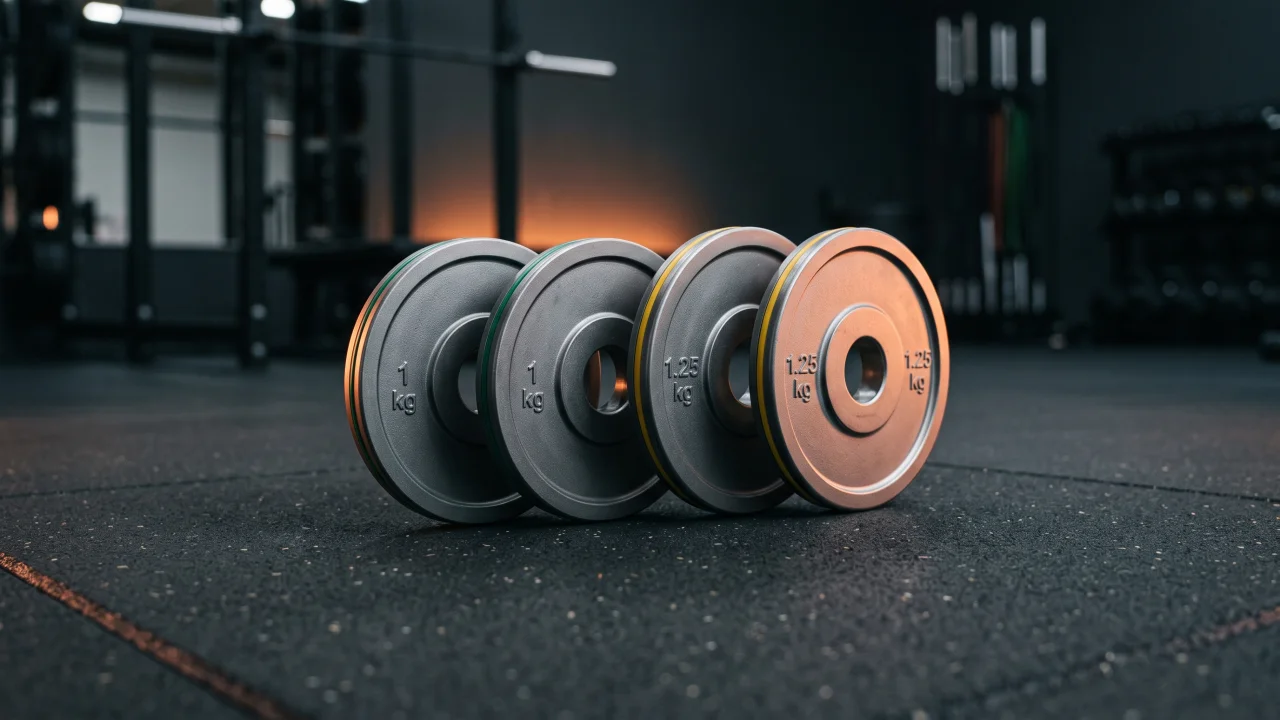
Many lifters stall because the next step up is simply too big. If your next available weight is 2 kg heavier than the one you use now, that can be a large jump for a small muscle. Microloading is the fix: moving up in very small steps so that progress never has to wait.
This article explains why small jumps matter, how to do them with the equipment you probably have, and when to use them.
Why a small jump can be a big jump
A jump is only small in kilograms, not in percentage. Going from 10 kg to 12 kg on a lateral raise is a 20 percent increase. Going from 100 kg to 102 kg on a squat is 2 percent. The same 2 kg feels completely different on each lift.
This is why small muscles and isolation exercises stall first. Dumbbell racks often go up in 2 kg steps, and for a curl or a lateral raise that is too much to handle in one session. The usual result is that you stay at the same weight for weeks, or you add the weight and lose a lot of reps.
- 10 kg to 12 kg: a 20 percent increase.
- 20 kg to 22 kg: a 10 percent increase.
- 100 kg to 102 kg: a 2 percent increase.
What microloading is
Microloading means using increments smaller than your gym's normal steps, such as 0.5, 1 or 1.25 kg per side or per dumbbell. The aim is to raise the demand by a small amount that you can handle without losing technique or reps.
Use it alongside adding reps, not instead of it. You add reps first, and when you reach the top of your range, you take a small step in weight instead of a big one.
How to microload with common equipment
You do not need special gear to start. There are several ways to get small steps in a normal gym, and you can mix them.
- Fractional plates: thin plates of 0.5, 1 or 1.25 kg that you add on each side of a barbell or a plate-loaded machine.
- Magnetic plates: small magnets that attach to the weight stack of a machine and add 0.5 to 1 kg.
- Pin positions: some machines let you place the pin between two plates to get a half step.
- Adjustable dumbbells: many models go up in steps of 1 to 2 kg, which is smaller than most fixed racks.
- Reps first: when you cannot add weight, add a rep and use that as your small step.
If your gym has none of these, two small plates from a sports store costs little and lasts for years. You can also ask the gym whether they can keep fractional plates at the weight area.
A microloading plan
A simple plan uses your rep range. Pick a range such as 8 to 12 reps. Work at the same load until you hit 12 reps on all your sets. Then add the smallest step available and go back to around 8 or 9 reps. Because the step is small, you will lose fewer reps and recover the top of the range faster.
For example, imagine you do the lateral raise with 8 kg for 3 sets of 12. You add 1 kg and now get 10, 9 and 8 reps. After a few sessions you are back at 12, 12 and 12 with 9 kg. Over several months, this kind of step adds up to a big change in load.
When microloading matters most
It matters most for isolation exercises and for small muscles: biceps, triceps, shoulders, calves and forearms. It also helps in the first and last weeks of a program, when you are close to your limit, and for anyone who is older, returning from a break or managing a sensitive joint.
For big compound lifts such as the squat or the deadlift, a 2.5 kg jump is often fine, and a small increase is still useful when you are close to your best.
Common mistakes
The first mistake is to add a tiny amount of weight and then rush through the reps. The step should keep your technique the same, not make the set easier or faster.
The second is to forget which plates you used. When the numbers are small, it is easy to lose track, and that is where a log helps a lot.
The third is to believe small steps are only for beginners. Advanced lifters use them more, because they have fewer big jumps left.
Microloading with bodyweight and cables
The same idea works outside the free weights. Many cable machines have a small plate that adds a half step. On bodyweight exercises such as pull-ups and dips, you can add a small amount of load with a belt or a backpack, or lower the weight more slowly before you add a rep.
If you cannot add any weight at all, treat reps as your microload. Going from 9 to 10 reps with the same weight is a step of about 11 percent in total work, and it counts as real progress. Write it down, because that is the number you want to beat next time.
Whatever the exercise, the rule stays the same: change one thing at a time, keep the technique identical and make the next step small enough that you can complete it.
Track small steps with eBolts
Small steps only work if you remember them. In eBolts you can adjust the load in steps of 1 kg, see your previous sets while you train, and compare week to week, so a half kilo of progress is visible and counted.
Frequently asked questions
What is microloading?
Microloading is the practice of increasing the weight in very small steps, such as 0.5, 1 or 1.25 kg, instead of the normal jumps of 2 to 5 kg. It lets you keep progressing on exercises where the usual increments are too large.
Do I need special plates to microload?
Not always. Fractional plates and magnetic plates make it easier, but you can also use half-step pin positions on machines, adjustable dumbbells with small increments, or simply add reps first. Many gyms can add fractional plates if you ask.
Is microloading only for beginners?
No. Beginners can often add weight quickly, but experienced lifters have fewer big jumps left. Small increments are especially useful for them, and for isolation exercises and small muscles at any level.
How do I know if the jump is too big?
If your reps fall a lot on the first set, your technique changes, or you struggle to reach the lower end of your rep range, the jump was too big. Go back one step and use a smaller increase or add reps first.
Should I microload every exercise?
No. Use small steps where the standard jump is a large percentage of your weight, mainly on isolation lifts and small muscle groups. On heavy compound lifts a jump of 2.5 kg is often fine.
Recommended gear
Affiliate links: we may earn a commission at no extra cost to you.
Put into practice: Routines & Guides
Follow workouts and detailed exercise biomechanics directly related to this article:
Track every set — free
Fractional loads, rest timer, history, last-time suggestions and progress charts. Works offline.
Create free account